Cricket fans love watching fast bowlers deliver thunderbolts that leave batters little time to react. From Shoaib Akhtar’s record-breaking pace to Shaun Tait’s explosive deliveries and Mitchell Starc’s deadly yorkers, some of the fastest bowlers in cricket history have pushed the limits of speed.
The highest recorded speed of a cricket ball is 161.3 km/h, bowled by Pakistan’s Shoaib Akhtar against England during the 2003 Cricket World Cup. Guinness World Records recognises this as the fastest electronically measured delivery in men’s cricket. However, bowling-speed readings can vary between measurement systems, and the ICC does not ratify individual bowling speeds as official world records.
Highest Speed Ball in Cricket History: Top 10 Fastest Deliveries
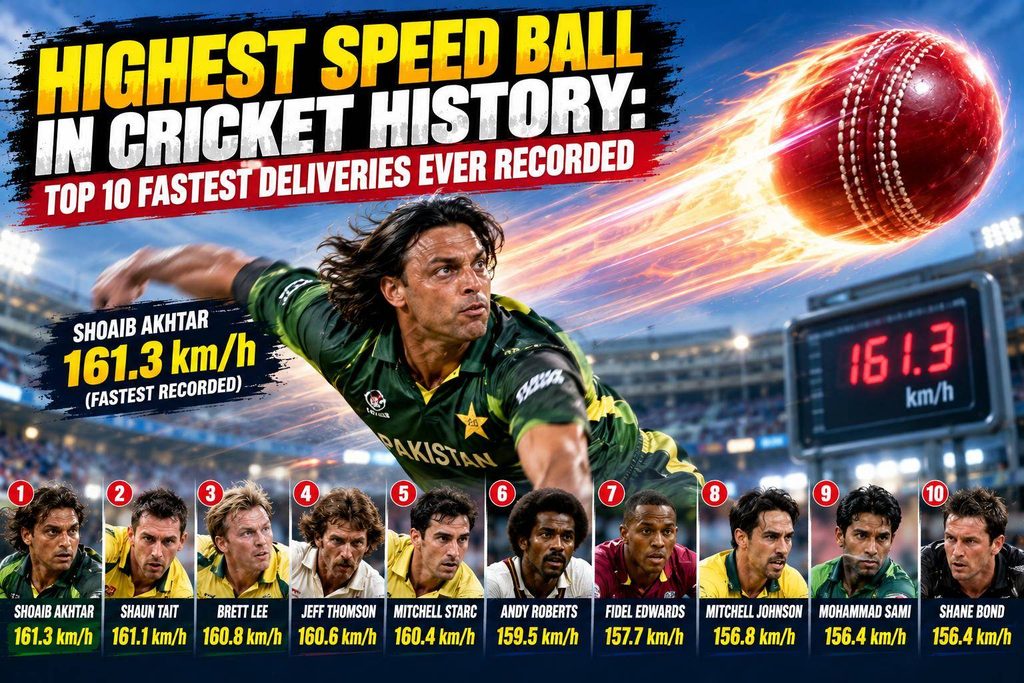
The following lists ten bowlers associated with some of the fastest deliveries reported in cricket history. The figures are drawn from published cricket records and historical reports, including Guinness World Records and ICC coverage where available. The ICC does not maintain an official ranking of the fastest individual deliveries, and historical speed measurements may differ between sources. Treat this list as a compilation of reported speeds rather than a definitive ranking.
| Rank | Bowler | Country | Reported speed | Opponent or context | Year |
| 1 | Shoaib Akhtar | Pakistan | 161.3 km/h | England | 2003 |
| 2 | Shaun Tait | Australia | 161.1 km/h | England | 2010 |
| 3 | Brett Lee | Australia | 160.8 km/h | New Zealand | 2005 |
| 4 | Jeff Thomson | Australia | 160.6 km/h | Historical speed report | 1975–76 |
| 5 | Mitchell Starc | Australia | 160.4 km/h | New Zealand | 2015 |
| 6 | Andy Roberts | West Indies | 159.5 km/h | Historical speed report | 1975 |
| 7 | Fidel Edwards | West Indies | 157.7 km/h | South Africa | 2003 |
| 8 | Mitchell Johnson | Australia | 156.8 km/h | England | 2013 |
| 9 | Mohammad Sami | Pakistan | 156.4 km/h | Zimbabwe | 2003 |
| 10 | Shane Bond | New Zealand | 156.4 km/h | India | 2003 |
1. Shoaib Akhtar: 161.3 km/h
Pakistan’s Shoaib Akhtar holds the recognised record for the fastest electronically measured delivery in men’s cricket. He bowled the famous 161.3 km/h delivery against England on 22 February 2003 at Newlands in Cape Town, South Africa, during the Cricket World Cup.
Known as the Rawalpindi Express, Akhtar became famous for his explosive run-up, aggressive bowling and extraordinary pace. His ability to bowl beyond 160 km/h made him one of the most intimidating fast bowlers of his generation.
Guinness World Records recognises this delivery as the fastest electronically measured ball in men’s cricket. However, the ICC does not certify individual bowling-speed readings as official world records because measurement equipment varies.
2. Shaun Tait: 161.1 km/h
Australia’s Shaun Tait ranks among the fastest bowlers ever recorded. His 161.1 km/h delivery was bowled against England at Lord’s in 2010 during a one-day international.
Tait relied on a powerful bowling action and an aggressive approach. His unusual action helped him generate exceptional pace, particularly in limited-overs cricket.
Although injuries and inconsistency affected his career, his ability to bowl at around 100 mph placed him among a very small group of exceptionally fast bowlers.
3. Brett Lee: 160.8 km/h
Brett Lee was one of Australia’s most exciting fast bowlers. He combined extreme pace with aggression, movement and the ability to attack the stumps.
Brett Lee is associated with a delivery reported at 160.8 km/h against New Zealand in 2005. Some historical accounts give a different figure of 161.1 km/h, so the precise speed varies between published records.
Lee enjoyed success in Test matches and one-day internationals. His pace, competitive approach and ability to challenge batters made him one of Australia’s most dangerous fast bowlers.
4. Jeff Thomson: 160.6 km/h
Jeff Thomson was a fearsome Australian fast bowler during the 1970s. His unusual bowling action and raw pace troubled batters long before modern speed-measurement systems became common.
Thomson is frequently credited with a speed of approximately 160.6 km/h in historical cricket records from the mid-1970s. The exact circumstances and measurement method are not directly comparable with modern match speed-gun readings, so the figure should be treated as a reported historical measurement rather than a uniformly verified match record.
His partnership with Dennis Lillee helped Australia develop one of the most feared pace attacks of that era. Thomson’s reputation for extreme speed remains an important part of cricket history.
5. Mitchell Starc: 160.4 km/h
Mitchell Starc is one of the fastest left-arm fast bowlers in modern cricket. On 15 November 2015, he bowled a delivery measured at 160.4 km/h against New Zealand at the WACA in Perth.
The delivery was a yorker that New Zealand batter Ross Taylor defended. Guinness World Records recognises it as the fastest ball bowled in a Test match.
Starc offers more than speed. His ability to swing the new ball, deliver accurate yorkers and attack the stumps makes him dangerous in international cricket.
6. Andy Roberts: 159.5 km/h
West Indies fast bowler Andy Roberts was a key member of the dominant West Indies pace attack of the 1970s and early 1980s. He was known for his aggression, tactical intelligence and ability to trouble batters with short-pitched deliveries.
Roberts is commonly credited with a speed of 159.5 km/h in historical cricket compilations. The precise match circumstances and measurement details are less firmly established than those of modern electronically recorded deliveries, so this figure should be treated as a reported historical speed.
Roberts was more than a fast bowler. His variations, control and ability to unsettle batters helped establish the West Indies as a dominant force in international cricket.
7. Fidel Edwards: 157.7 km/h
West Indies fast bowler Fidel Edwards was known for his skiddy action and impressive pace. His fastest delivery is commonly reported at 157.7 km/h against South Africa in 2003.
Edwards could surprise batters with his speed and unusual release angle. Despite not being the tallest fast bowler, he generated enough pace to trouble experienced international players.
His performances earned him recognition as one of the quickest bowlers of his generation.
8. Mitchell Johnson: 156.8 km/h
Mitchell Johnson was an Australian left-arm fast bowler who could dominate matches with pace, bounce and movement.
His fastest delivery is widely reported at 156.8 km/h against England in 2013. He became particularly famous during the 2013–14 Ashes series, when his aggressive bowling helped Australia regain the Ashes.
Johnson demonstrated how pace becomes even more effective when a bowler combines it with accuracy, bounce and confidence.
9. Mohammad Sami: 156.4 km/h
Pakistan’s Mohammad Sami was another fast bowler capable of producing extraordinary speed. His top delivery is commonly listed at 156.4 km/h against Zimbabwe in 2003.
Sami had the ability to trouble batters with quick deliveries and attacking spells. However, maintaining accuracy and consistency was sometimes a challenge during his international career.
His reported speed remains a notable achievement in the history of Pakistan’s fast-bowling tradition.
10. Shane Bond: 156.4 km/h
New Zealand’s Shane Bond was among the quickest bowlers of the early 2000s. His fastest delivery is commonly reported at 156.4 km/h against India in 2003.
Bond combined pace with late movement and impressive control. When fit, he could dismantle strong batting line-ups with short, aggressive spells.
Injuries limited his international career, but his performances established him as one of New Zealand’s most dangerous fast bowlers.
Why Is Shoaib Akhtar’s Record So Difficult to Beat?
Bowling a cricket ball above 160 km/h requires an exceptional combination of strength, technique, coordination and timing. A fast bowler must build momentum during the run-up and transfer energy efficiently through the body before releasing the ball.
Maintaining that pace is even more difficult. Fast bowlers need to land the ball accurately, control their direction and manage the physical demands of repeated high-intensity bowling.
Measurement technology also matters. Different speed guns can produce different readings, and older measurements may not be directly comparable with modern broadcast systems. This is one reason historical bowling-speed records need careful verification.
Has Anyone Bowled Faster Than 161.3 km/h?
No delivery has been reliably recorded as faster than Shoaib Akhtar’s recognised 161.3 km/h.
Shaun Tait and Brett Lee are both credited with deliveries approaching 161 km/h, while Mitchell Starc recorded 160.4 km/h in a Test match. These deliveries demonstrate how a small group of bowlers have approached or crossed the 160 km/h mark.
In December 2024, a broadcast reading showed Mohammed Siraj bowling at 181.6 km/h during a Test against Australia in Adelaide. The reading was attributed to a technical error, not an actual delivery speed.
This incident highlights why an unusually high speed reading must be checked before it is accepted as a genuine record. A separate speed-gun anomaly was also reported during the Perth Test in the same series, when India spinner Washington Sundar was shown at 140.6 km/h. These incidents demonstrate why broadcast readings should be checked against reliable reporting rather than automatically accepted as genuine bowling speeds.
Who Is the Fastest Indian Bowler?
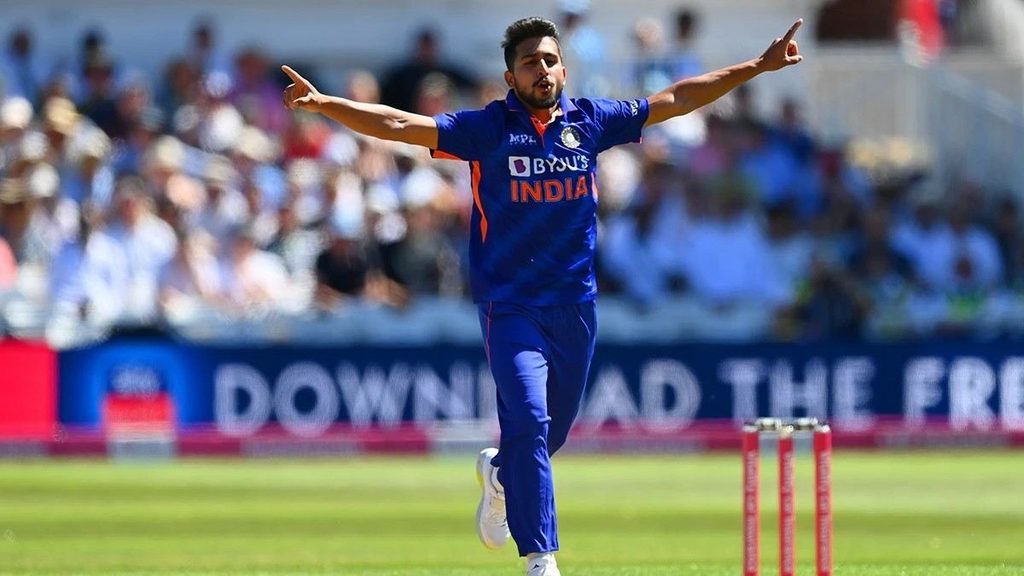
Image Source: Dailyo
Umran Malik is credited with India’s fastest delivery in international cricket, a 155 km/h ball against Sri Lanka in January 2023. A separate 156 km/h reading against the same opponents in Guwahati is also widely reported, but questions have been raised about the speed gun’s accuracy on that occasion. Malik’s fastest widely reported delivery overall was 157 km/h for Sunrisers Hyderabad against Delhi Capitals at Brabourne Stadium on 5 May 2022 in the IPL. Mayank Yadav’s 156.7 km/h delivery in IPL 2024 came close to Malik’s IPL mark. These figures refer to different competitions and should not be confused. Record status can change with future performances.
Although Malik has demonstrated impressive pace, his reported international speed remains below Akhtar’s recognised world record of 161.3 km/h.
What Makes a Cricket Ball Travel So Fast?
Several factors influence how quickly a bowler can deliver the ball.
Run-up: A powerful, controlled approach helps a bowler build momentum before entering the delivery stride.
Bowling technique: Efficient body rotation and energy transfer help generate greater release speed.
Strength and coordination: Strong legs, core muscles and shoulders support the movements required for fast bowling.
Release timing: Small technical differences can affect the speed at which the ball leaves the hand.
Fitness and recovery: Conditioning and sufficient recovery help bowlers maintain their pace while reducing injury risk.
However, speed alone does not guarantee wickets. Swing, seam movement, bounce, accuracy and changes in pace can be just as important in defeating a batter.
Conclusion
Shoaib Akhtar’s 161.3 km/h delivery against England in the 2003 Cricket World Cup remains the recognised benchmark for the highest electronically measured bowling speed in men’s cricket. Shaun Tait, Brett Lee, Jeff Thomson and Mitchell Starc are among the other bowlers associated with remarkable recorded speeds.
Although modern training and technology continue to help fast bowlers improve, Akhtar’s record remains unmatched by a reliably verified delivery. Since bowling-speed measurements are not certified as official world records by the ICC, historical figures should always be presented with appropriate context and credible sources.
Frequently Asked Questions
Pakistan’s Shoaib Akhtar holds the recognised record with a delivery measured at 161.3 km/h against England during the 2003 Cricket World Cup.
A speed of 161.3 km/h is approximately 100.2 mph, placing Akhtar among the very few bowlers credited with exceeding 100 mph.
Mitchell Starc recorded a delivery of 160.4 km/h against New Zealand in Perth on 15 November 2015. Guinness World Records recognises it as the fastest ball bowled in a Test match.
No delivery at 170 km/h or faster has been reliably verified as the cricket speed record. Extremely high broadcast readings, including Mohammed Siraj’s 181.6 km/h reading in 2024, have been attributed to technical errors.
Umran Malik is credited with India’s fastest international delivery at 155 km/h against Sri Lanka in January 2023, although a separate 156 km/h reading from Guwahati has been questioned. His 157 km/h delivery in the IPL in 2022 was recorded in a different competition.