Cricket has several ways for a batter to lose their wicket, but some dismissals are more unusual than others. One such situation is retired out in cricket. It allows a batter to end their innings voluntarily and be recorded as out without being dismissed through a conventional method such as bowled, caught or run out.
This rule has attracted attention in T20 cricket, where teams sometimes make tactical decisions to increase their scoring rate. A captain may decide that another batter has a better chance of hitting boundaries during the final overs. But what does retired out mean, how does the rule work, and how is it different from retired hurt?
What Is Retired Out in Cricket?
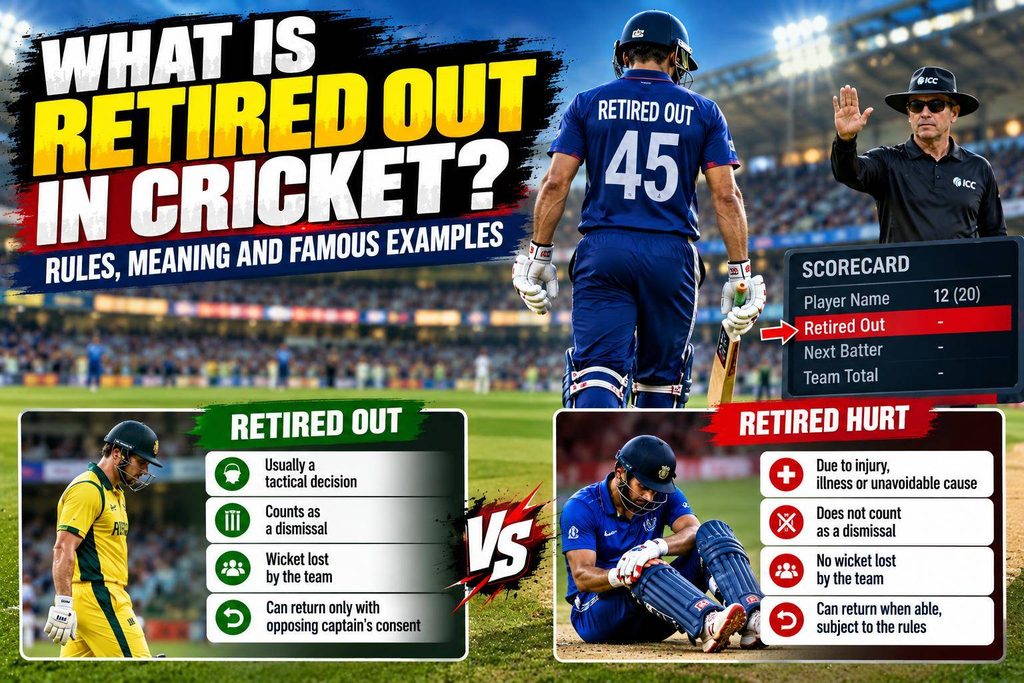
Retired out in cricket means a batter voluntarily ends their innings for a reason other than illness, injury or another unavoidable cause. If the batter does not resume the innings under the applicable rules, they are recorded as retired out.
According to Law 25.4 of the Laws of Cricket, a batter may retire when the ball is dead. The umpires must be informed of the reason before play continues. If the batter retires for a reason other than illness, injury or another unavoidable cause, they may resume their innings only with the opposing captain’s consent.
In simple terms, retired out counts as a dismissal. The batting team loses a wicket, and another eligible batter can take the crease.
Teams may use this rule as a tactical move, especially in limited overs cricket. For example, a batter who is struggling to score quickly may retire so that a more aggressive player can face the remaining deliveries.
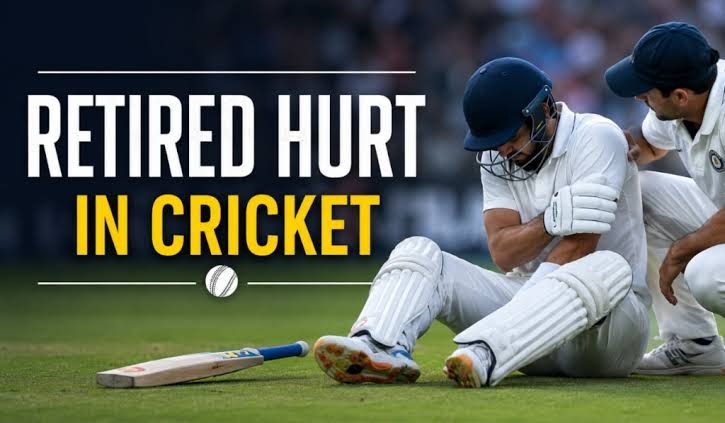
The rule is different from retired hurt, where a batter leaves the field because of illness, injury or another unavoidable cause.
For the official wording, consult the MCC Laws of Cricket and the ICC playing conditions.
How Does Retired Out Work in Cricket?
Retired out is not an ordinary dismissal caused by the bowler or a fielder. It occurs when a batter voluntarily ends their innings and the circumstances meet the requirements of the applicable rules.
Here is how the process works:
- The batter retires while the ball is dead.
- The umpires are informed of the reason before play resumes.
- If the retirement is for a reason other than illness, injury or another unavoidable cause, the batter may resume only with the opposing captain’s consent.
- If the innings is not resumed, the batter is recorded as retired out.
- The batting team loses a wicket, and another eligible batter can take the crease.
Under MCC Law 25.4, a batter who is allowed to resume may return only when a wicket falls or another batter retires. The applicable competition playing conditions must also be followed.
These rules mean that a batter cannot simply walk off while the ball is in play and expect the innings to end under the retirement rule. The ball must be dead, and the umpires must be informed.
Retired Out vs Retired Hurt in Cricket
Retired out and retired hurt may sound similar, but they have different meanings and consequences. The main difference is why the batter leaves the field and whether the departure counts as a dismissal.
| Feature | Retired out | Retired hurt |
| Main reason | Usually a tactical decision | Illness, injury or another unavoidable cause |
| Counts as a dismissal | Yes, if the innings is not resumed | No |
| Wicket lost by the team | Yes | No |
| Can the batter return? | With the opposing captain’s consent, subject to the rules | The batter is entitled to resume when able, subject to the rules |
| Scorecard entry | Retired out | Retired not out if the batter does not return |
| Common situation | A team wants a more aggressive batter | A batter cannot continue because of an injury |
For example, imagine a batter has scored 12 runs from 20 balls in a T20 match. With only two overs remaining, the captain may decide that another batter has a better chance of scoring quickly. If the first batter retires for tactical reasons and does not return, the scorecard records the batter as retired out.
Now imagine a batter suffers a hamstring injury while running between the wickets. They leave the field because they cannot continue. This is generally recorded as retired hurt, not retired out.
The distinction matters because retired hurt does not automatically cost the batting team a wicket.
Why Do Teams Use Retired Out in T20 Cricket?
T20 cricket gives each team a maximum of 20 overs in a full innings. Every delivery can influence the final score, particularly during the closing overs.
Teams may use retired out for several tactical reasons.
1. To increase the scoring rate
A batter may struggle to score boundaries against a particular bowler. Replacing that batter with a powerful hitter can give the team a better chance of scoring quickly.
2. To use the remaining deliveries effectively
If only a few balls remain, the captain may prefer a batter who can attack immediately rather than one who needs time to settle.
3. To improve the batting combination
A team may want a different batter at the crease because of their power hitting, ability to handle particular bowlers or suitability for the match situation.
However, retired out carries a risk. The replacement batter might get out immediately, leaving the team with fewer wickets and little improvement in the score.
Famous Examples of Retired Out in Cricket
Several professional matches have demonstrated how teams use this rule in different circumstances.
| Player | Team | Match or competition | Key detail |
| R. Ashwin | Rajasthan Royals | IPL 2022 against Lucknow Super Giants | Became the first batter in IPL history to be tactically retired out on 10 April 2022 |
| Niko Davin | Namibia | Men’s T20 World Cup 2024 against England | Retired after scoring 18 runs from 16 balls |
| George Balderson | Lancashire | T20 Blast 2025 semi final against Somerset | Retired after scoring 7 runs from 6 balls |
R. Ashwin in IPL 2022
R. Ashwin became the first batter in Indian Premier League history to be tactically retired out on 10 April 2022, during Rajasthan Royals’ match against Lucknow Super Giants at the Wankhede Stadium in Mumbai. Ashwin scored 28 runs off 23 balls before leaving the field to allow Riyan Parag to bat with 10 balls remaining in the innings.
Parag scored eight runs off four balls, and Rajasthan Royals finished on 165/6 before winning the match by three runs. The incident brought the retired out rule into mainstream IPL discussions and demonstrated how teams could use retirement as a tactical batting decision.
The decision attracted attention because it demonstrated how a team could use retired out as a planned tactical move rather than treating it only as an unusual scorecard entry.
Niko Davin in the 2024 T20 World Cup
Namibia’s Niko Davin was recorded as retired out against England in a rain-affected Men’s T20 World Cup match on 15 June 2024.
Davin scored 18 runs off 16 balls during Namibia’s chase of a revised target of 126 in 10 overs. England had scored 122/5 in their 10-over innings. Namibia finished on 84/3, and England won by 41 runs under the Duckworth-Lewis-Stern (DLS) method.
The match demonstrated how a tactical retirement could be considered in a shortened innings when a team needed to maximise its scoring rate.
George Balderson in the 2025 T20 Blast
Lancashire used the retired out tactic during their T20 Blast semi-final against Somerset on 13 September 2025. George Balderson retired out after scoring seven runs off six balls while Lancashire were chasing a target of 183.
When Tom Hartley came to the crease, Lancashire needed 31 runs from 10 balls. Hartley was caught off his first delivery without scoring. Balderson had also taken 3/31 with the ball earlier in the match.
Somerset scored 182/7 before bowling Lancashire out for 159, winning by 23 runs. The incident highlighted the risks of tactical retirement: replacing a batter does not guarantee a faster scoring rate or a successful chase.
UAE’s Unusual Tactic in the 2025 Women’s T20 World Cup Asia Qualifier
The United Arab Emirates used an unusual tactic against Qatar on 10 May 2025. After reaching 192 without losing a wicket in 16 overs, the UAE retired all 10 batters out to end their innings early because of the threat of rain.
Ben Cox The UAE subsequently bowled Qatar out for 29 runs, securing a dominant victory. The match became a remarkable example of how tactical retirements can be used for reasons beyond increasing the scoring rate.
Roston Chase in the 2025 West Indies vs Pakistan T20I
Roston Chase was retired out after scoring 15 runs off 12 balls during the third T20 International between West Indies and Pakistan on 3 August 2025. The decision came as West Indies tried to maximise their scoring in the closing stages of the innings.
West Indies finished on 176/6, and Pakistan won by 13 runs. Chase’s dismissal is a notable example of the tactical retirement strategy being used in men’s international T20 cricket.
What Happens to a Batter’s Score When They Retire Out?
A batter’s runs remain part of the team’s total even when the batter is recorded as retired out. For example, if a batter scores 35 runs before retiring out, those 35 runs remain on the scorecard.
The innings is also counted as a dismissal when calculating the batter’s batting average. However, the dismissal is not credited to the bowler as a wicket.
This differs from retired hurt. A batter who retires hurt and does not return is recorded as retired not out. The innings is not counted as a dismissal for batting average purposes.
Retired out can therefore affect both the team’s remaining wickets and the batter’s individual statistics.
Can a Batter Who Retires Return to Bat?
Yes. Under MCC Law 25.4, a batter who retires for a reason other than illness, injury or another unavoidable cause may resume their innings only with the opposing captain’s consent. The batter may return only when a wicket falls or another batter retires, subject to the applicable playing conditions.
A batter who retires because of illness, injury or another unavoidable cause may resume their innings when able to do so, subject to the Laws of Cricket.
If a batter retires for a tactical reason and does not resume their innings, they are recorded as retired out. Once the scorecard records the batter as retired out, that innings has ended; the batter cannot return to continue it.
Always check the applicable competition playing conditions alongside the Laws of Cricket.
Is Retired Out Allowed in All Cricket Formats?
Retired out is recognised under the Laws of Cricket, but its use varies between formats and match situations.
In Test cricket, tactical retirements are uncommon because teams generally have more time to build an innings. In ODI cricket, the rule may be relevant when a team wants to change its scoring approach. In T20 cricket, it attracts more attention because every remaining delivery can be valuable.
The rule is not limited to T20 matches. However, whether a batter can resume their innings and how the retirement is recorded must be determined according to the relevant playing conditions.
Conclusion
Retired out in cricket occurs when a batter voluntarily ends their innings for a reason other than illness, injury or another unavoidable cause and is recorded as out under the applicable rules. Unlike retired hurt, it counts as a dismissal and costs the batting team a wicket.
The tactic is particularly visible in T20 cricket, where captains may use it to bring in a more aggressive batter during the final overs. Examples involving R. Ashwin, Niko Davin and George Balderson show both the potential benefits and the risks.
Understanding the difference between retired out and retired hurt makes it easier to read scorecards and follow the tactical decisions behind modern cricket.
Frequently Asked Questions
Retired out means a batter ends their innings for a reason other than illness, injury or another unavoidable cause and is recorded as out if the innings is not resumed under the applicable rules.
No. Retired out counts as a dismissal. Retired hurt applies when a batter leaves because of illness, injury or another unavoidable cause and is not counted as a dismissal if the batter does not return.
Yes. It counts as a dismissal against the batting team, but the wicket is not credited to the bowler.
No. Once a batter is recorded as retired out, their innings has ended. However, a batter who retires for a tactical reason may resume their innings with the opposing captain’s consent, and only when a wicket falls or another batter retires. If they do not resume, they are recorded as retired out.
Teams may retire a batter out to bring in a more aggressive player, increase the scoring rate or use the remaining deliveries more effectively. It is a tactical decision that can help or hurt the team’s chances of winning.