
The longest six in cricket history is a fascinating topic for fans who love powerful batting. Over the years, several batters have hit extraordinary sixes that travelled remarkable distances. From Brett Lee’s famous shot at the Gabba to Tim David’s reported 129-metre hit against India in 2025, these moments have become part of cricket’s power-hitting history.
However, identifying the longest six in cricket history is not straightforward. Cricket does not have a universally recognised, officially certified all-time record for six distance. Some figures come from broadcast reporting, while others are historical estimates based on video footage, stadium dimensions and trajectory analysis. Shahid Afridi’s widely reported 153-metre six, for example, has been challenged by specialist analysis.
Top 10 Longest Sixes in Cricket History
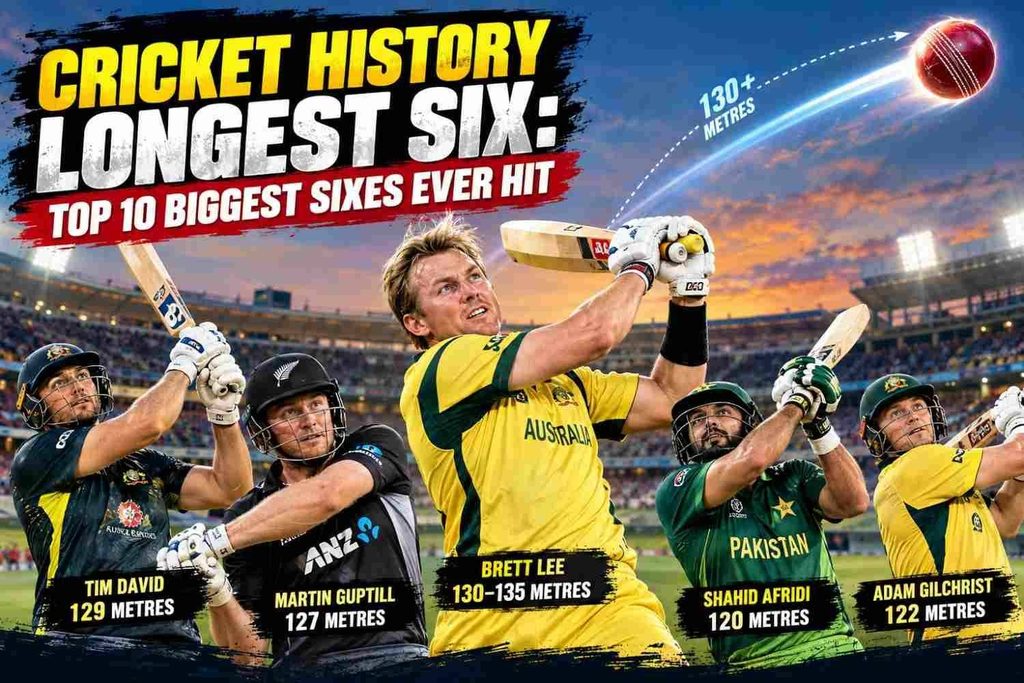
The following lists 10 widely discussed long sixes from international, franchise, domestic and historical cricket. The distances are reported figures or estimates, not a definitive official world ranking.
| No. | Player | Reported Distance | Opponent | Year |
| 1 | Brett Lee | 130–135 metres (estimated) | West Indies, Gabba Test | 2005 |
| 2 | Aiden Blizzard | Around 130 metres (reported) | Domestic T20 at the WACA | 2008 |
| 3 | Tim David | 129 metres (broadcast-reported projection) | India, third T20I | 2025 |
| 4 | Martin Guptill | 127 metres (trajectory-based estimate) | South Africa, T20I | 2012 |
| 5 | Albie Morkel | Around 124–125 metres (reported) | Deccan Chargers, IPL | 2008 |
| 6 | Simon O’Donnell | Around 122 metres (estimated) | New South Wales, Sheffield Shield | 1993 |
| 7 | Adam Gilchrist | Around 122 metres (reported) | IPL | 2011 |
| 8 | Victor Trumper | Around 120–125 metres (historical estimate) | Club cricket, Redfern Oval | 1903 |
| 9 | Mark Waugh | Around 120 metres (estimated) | New Zealand, WACA | 1997 |
| 10 | Shahid Afridi | Around 120 metres (specialist estimate) | South Africa, ODI | 2013 |
Note: This is an indicative list, not an officially confirmed ranking. The distances are based on different methods and vary in reliability. Some are broadcast-reported projections, while others are historical estimates. The figures should not be treated as directly comparable measurements.
1. Brett Lee – Estimated 130–135 Metres Against West Indies
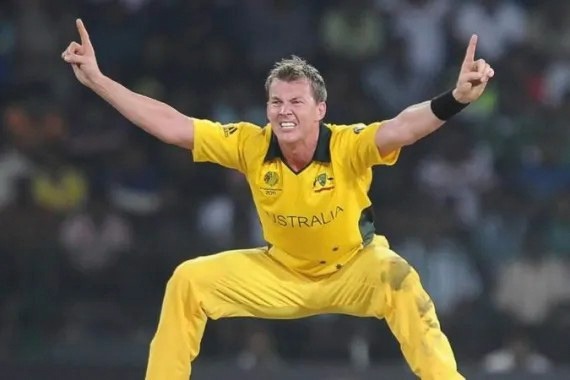
Australian fast bowler Brett Lee is associated with one of cricket’s most remarkable historical sixes. He struck the shot against the West Indies at the Gabba in Brisbane during a Test match in 2005. Specialist analysis by cricket writer Charles Davis estimated the shot’s unimpeded distance at approximately 130–135 metres.
The hit is particularly notable because Lee used a carbon-fibre-reinforced bat, a non-standard design that was subsequently banned. The reported distance is based on retrospective analysis rather than a universally certified measurement of the ball’s flight.
Lee’s six remains one of the most frequently discussed examples of extraordinary power hitting. However, the commonly circulated 143-metre figure should not be presented as a confirmed measurement. The more cautious 130–135-metre estimate better reflects the limitations of the available evidence.
2. Aiden Blizzard – Around 130 Metres in Domestic T20 Cricket
Australian batter Aiden Blizzard is associated with a reported 130-metre six during a domestic T20 final at the WACA in 2008. The shot is frequently mentioned in discussions about the longest sixes in Australian cricket.
Blizzard was known for his aggressive batting in shorter formats. Specialist analysis has discussed the shot as a remarkable long hit and noted the influence of the wind. The reported distance should be understood in the context of the available historical evidence, rather than as a precisely certified measurement.
This example also illustrates why the method used to describe a six matters. The distance to the ball’s landing point, its subsequent movement after landing and an estimated unimpeded trajectory are different measurements. The reported figure should therefore be treated as an estimate, not an officially established record.
3. Tim David – 129 Metres Against India
Australian batter Tim David struck a reported 129-metre six against India during the third T20 International at Hobart on 2 November 2025. The shot came off Indian spinner Axar Patel and struck a stadium sign or roof structure during its flight.
David scored 74 runs from 38 balls, including five sixes. The enormous straight hit attracted considerable attention during the match and became one of the standout moments of his innings.
The 129-metre figure was reported in match coverage as a projected distance had the ball not been interrupted by the structure. It should therefore be described as a broadcast-reported projection, not a confirmed measurement of the ball’s actual unobstructed flight. Nevertheless, it is one of the more clearly documented modern examples of an exceptionally long six.
4. Martin Guptill – 127 Metres Against South Africa
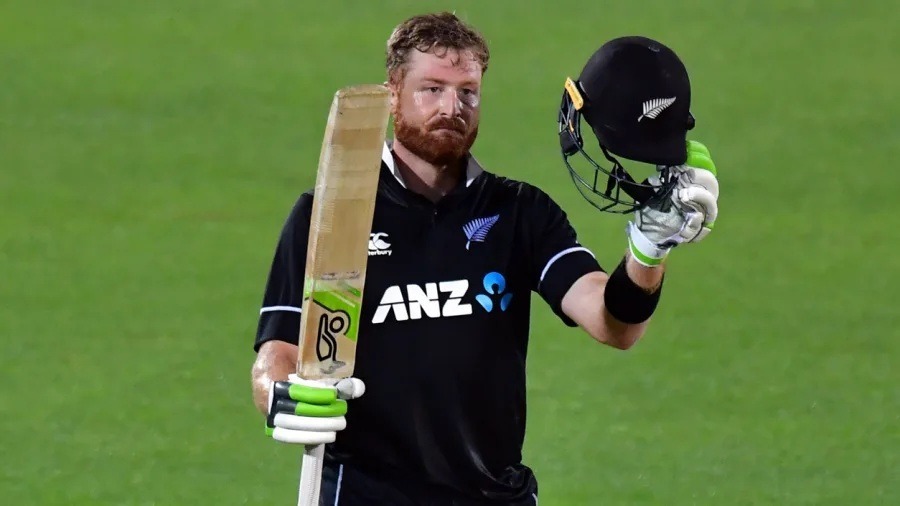
New Zealand batter Martin Guptill is widely associated with a 127-metre six against South Africa in Wellington in 2012. The shot is frequently discussed among cricket’s longest reported sixes.
The ball struck the roof of a stadium stand. Specialist analysis used trajectory-tracking information to estimate how far the ball might have travelled without the obstruction. This helps explain why the reported distance differs from the horizontal distance between the batter and the point where the ball struck the structure.
Guptill was renowned for his powerful stroke play in limited-overs cricket. His hit is an important example of how trajectory-based estimates can help assess long sixes, although the figure should not be confused with a universally certified measurement.
5. Albie Morkel – Around 124–125 Metres in the IPL
South African all-rounder Albie Morkel is associated with a huge six during the 2008 Indian Premier League season. The shot against Deccan Chargers in Chennai is commonly reported to have travelled approximately 124–125 metres.
Morkel was valued for his power hitting and ability to score quickly in the lower middle order. His strength and aggressive approach made him a dangerous batter in T20 cricket, where clearing the boundary can change the momentum of an innings.
The distance is widely quoted in discussions of cricket’s biggest sixes. However, it should be described as a reported figure rather than a universally verified measurement, as historical distance claims do not all come from the same tracking system.
6. Simon O’Donnell – Around 122 Metres in Sheffield Shield Cricket
Former Australian all-rounder Simon O’Donnell is credited with a reported 122-metre six during a Sheffield Shield match against New South Wales at the Melbourne Cricket Ground in 1993.
This entry is notable because it comes from domestic first-class cricket rather than an international match. Lists of cricket’s longest sixes often combine international matches, franchise tournaments and domestic competitions, so the match context is important when comparing different claims.
The distance is an estimate associated with historical analysis rather than a measurement from a modern broadcast-tracking system. It is best presented as a notable reported long hit, not as a confirmed world record.
7. Adam Gilchrist – Around 122 Metres in the IPL
Former Australian wicketkeeper-batter Adam Gilchrist is associated with a reported 122-metre six during the 2011 Indian Premier League season. Gilchrist was known for attacking bowlers from the start of an innings and was one of the most influential opening batters in limited-overs cricket.
His aggressive batting helped demonstrate the value of powerful wicketkeeper-batters in T20 competitions. He combined quick scoring with the ability to clear the boundary, making him a major threat to opposing bowling attacks.
The reported distance is frequently included in discussions of the longest sixes in cricket. However, unless a reliable source establishes the exact measurement and match details, the figure should remain labelled as reported rather than presented as an independently verified distance.
8. Victor Trumper – Historical Estimate of 120–125 Metres
Victor Trumper, one of Australia’s celebrated early-era batters, is sometimes included in historical discussions of exceptionally long sixes. A shot associated with club cricket at Redfern Oval in 1903 has been estimated at approximately 120–125 metres.
Claims from this period require particular caution. Modern ball-tracking systems were not available, and historical reports do not provide the same measurement evidence as contemporary broadcasts. The original distance cannot be independently confirmed to the same standard as a modern tracked shot.
Trumper’s entry is therefore best understood as a historical estimate rather than a directly verified record. It illustrates how cricket’s history includes extraordinary hitting claims whose precise distances remain uncertain.
9. Mark Waugh – Estimated 120 Metres Against New Zealand
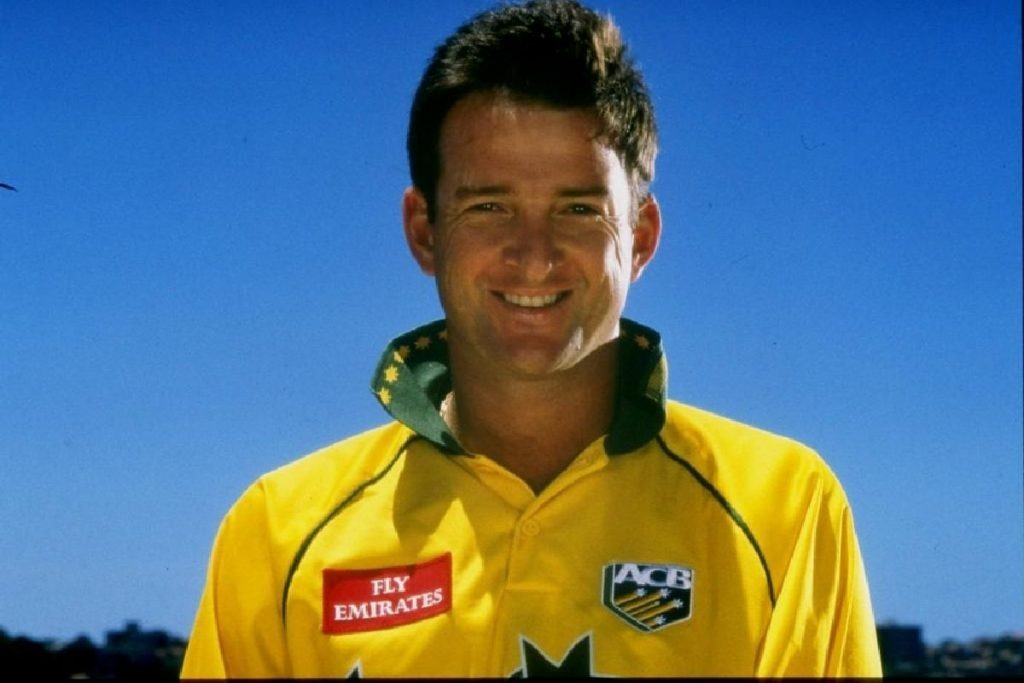
Former Australian batter Mark Waugh is associated with a long six against New Zealand at the WACA in Perth in 1997. The shot reportedly reached the roof of the Lillee–Marsh Stand.
Analysis of the ground layout has been used to estimate the shot’s unimpeded distance at around 120 metres. This makes the claim more carefully examined than many unsupported long-six stories, although the figure remains an estimate rather than a universally certified measurement.
Waugh was admired for his timing and elegant stroke play. His reported six is a reminder that extraordinary distance does not always depend on brute force alone; timing, bat speed, contact and trajectory also influence how far a cricket ball travels.
10. Shahid Afridi – Around 120 Metres Against South Africa
Pakistan all-rounder Shahid Afridi is widely credited online with a 153-metre six against South Africa at the Wanderers Stadium in Johannesburg on 17 March 2013. The figure has been repeated in numerous cricket articles and is often presented as the longest six in cricket history.
However, specialist analysis by Charles Davis challenged the 153-metre claim. The analysis estimated the shot’s unimpeded distance at closer to 120 metres. Afridi also struck two enormous shots during the South African tour, which makes identifying the specific hit important when discussing the reported distances.
Afridi scored 88 runs from 48 balls in the ODI, demonstrating the aggressive batting that made him famous. The innings remains memorable, but the 153-metre figure should not be presented as a confirmed measurement. The approximately 120-metre estimate is a more cautious description of the specialist analysis.
How Is the Distance of a Six Measured?
The distance of a six can be estimated using broadcast tracking, video footage, stadium dimensions and the projected trajectory of the ball. Modern tracking technology can provide useful information about a shot’s path, but many older hits do not have comparable measurements.
A ball landing beyond a stand or striking a roof does not automatically establish how far it travelled through the air. Analysts may need to reconstruct its trajectory and account for the height and location of the obstruction.
Published lists therefore differ because they may use different definitions and measurement methods. Some figures are reported by broadcasters, others are estimates based on video or stadium layouts, and some historical claims have limited supporting evidence. Any article presenting a six distance as a record should explain whether the figure is measured, projected, estimated or disputed.
Frequently Asked Questions
Brett Lee’s six has been estimated at 130–135 metres, while Tim David’s 129-metre hit was reported in 2025. No universally certified all-time record exists.
The 153-metre claim is disputed. Specialist analysis estimated the shot’s unimpeded distance at around 120 metres.
The 143-metre figure is not confirmed. Specialist analysis estimates his famous six at 130–135 metres.
There is no universally recognised ICC-certified all-time record for the longest six in cricket.
The 129-metre distance was reported as a projection in match coverage, not a certified measurement of the ball’s actual flight.
Websites use different sources, including broadcast reports, historical accounts and trajectory estimates. Therefore, reported distances can vary.
Final Thoughts
Cricket’s longest sixes demonstrate the power, timing and skill of batters across international, franchise and domestic cricket. Brett Lee, Aiden Blizzard, Tim David, Martin Guptill, Albie Morkel and Shahid Afridi are among the players frequently discussed in connection with extraordinary hits.
However, the distances associated with these shots do not all have the same level of evidence. Tim David’s 129-metre hit was reported in match coverage as a projection, while several older figures are estimates based on video analysis and stadium layouts. Afridi’s famous 153-metre claim remains disputed by specialist analysis.
For accuracy, this list should be treated as a collection of notable long-six claims rather than an official world ranking. Clearly distinguishing reported figures, historical estimates and disputed claims allows readers to understand the evidence without presenting uncertain distances as established facts.